How a class 7 kid picked volleyball because it looked like the easiest game, played every tournament as a first-year at IGIT Sarang, switched from setter to spiker after watching Kageyama and Hinata, and learned what teamwork and resilience really mean.

I should start with a confession, because the whole story rests on it: I chose volleyball because I thought it was the easiest game. I was in class 7, and until then I had not really played anything at all, no cricket, no football, nothing that asked me to run around with any real purpose. Then I saw volleyball, and my young and very confident brain looked at a big ball, a net and a few people standing around, and decided it could not possibly be that hard. It turned out to be one of the hardest things I have ever tried to get good at, and also the best wrong decision I have ever made.
Falling for it by accident
What nobody tells you about volleyball is that the ball is always in a hurry. You get three touches before it has to go over, and you cannot hold it, carry it or take a moment to think, so every rally becomes a tiny negotiation between six people who have about a second to agree on a plan. I did not fall in love with the game because I was good at it. I fell in love because I was not, and it kept quietly asking me to come back and try again, until somewhere in my school days it stopped being a game I had picked by accident and became the game I could not stop thinking about.
Starting as a setter
My first real position was setter, which, if you have never played, is the person who takes the second touch and decides who gets to attack. It is a job with very little glory, because the spiker gets the loud moment and the crowd reacts to the hit while the setter jogs quietly back into position, even though almost every good attack starts in the setter's hands. You spend the whole rally watching everyone else, where the blockers are leaning, which hitter is ready and who is out of breath, and you become the brain of the team in a sport where brains do not get much applause. Looking back, it taught me to pay attention to other people before thinking about myself, which is a pretty good lesson for a kid to learn on a court.
Then I met Kageyama and Hinata
And then I watched Haikyuu. If you have not seen it, it follows the Karasuno High School volleyball team, a school that was once strong and is now written off as the "fallen crows", and at its centre are two first-years who cannot stand each other when they first meet.
Kageyama is a brilliant setter, so talented and so demanding that his old teammates called him the "King of the Court", and they did not mean it kindly, because his sets were perfect for him rather than for the people who had to hit them. His whole arc is learning that a set is only good if the hitter can actually use it. Hinata, on the other hand, is short and loud and has no business being as good at jumping as he is, and when the story begins he has almost no technique at all, only speed, an absurd vertical and a refusal to give up that borders on the unreasonable. Put the two of them together and you get the freak quick, where Hinata sprints and jumps with his hand already swinging and Kageyama puts the ball exactly where that hand is going to be, with Hinata not even looking at the ball at first and simply trusting that it will arrive.
As a setter, I watched Kageyama and thought that I knew exactly how hard that was. Then I watched Hinata, and a thought arrived that I had not expected at all: I wanted to be the one in the air.
College, and a real team
Then came college, and volleyball stopped being just a school thing. At IGIT Sarang I started playing at a proper competitive level, for the college team and against other colleges, and from my very first year I got to travel with the team to every tournament. As a first-year, that was a privilege I did not take lightly, and I was quietly, deeply proud of it, because it felt like all those years of chasing a ball I once thought was easy had added up to something real.
From setter to spiker
College is also where I finally made the switch. I had set all through school, but at IGIT, with Kageyama and Hinata still living rent-free in my head, I moved to spiker.
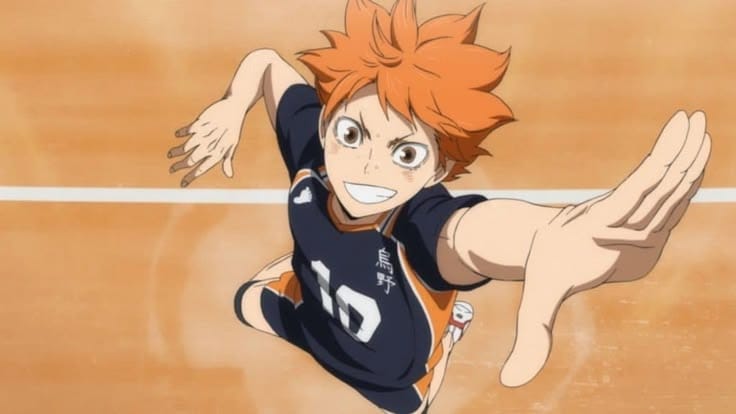
Hinata, mid-air, about to have the best moment of his week.
Going from setting to spiking felt like walking from backstage onto the stage, and everything I thought I knew about timing had to be relearned from the other side, where you approach, jump and swing while trusting that the ball will arrive where you are going to be rather than where you are. The part that surprised me most was that being a setter first made me a better spiker. I already knew what the setter could see from their spot, I knew that a sloppy first pass makes a perfect set almost impossible, and I knew that when a set is a little off, the hitter's job is to make it work rather than to complain about it, because I had been on the other end of that conversation for years. Haikyuu keeps coming back to "the view from the top", the view a spiker gets at the peak of a jump, and the show never once pretends that anyone gets up there alone.
Me vs me
Sometimes I think about the two versions of me standing on the same court.
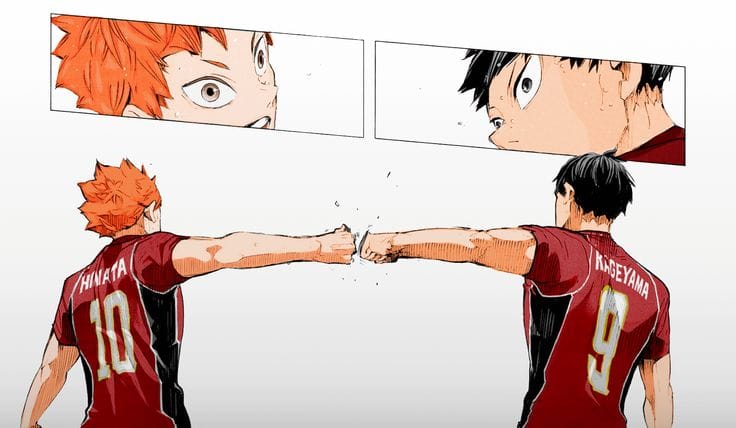
Number 9 and number 10. Setter me and spiker me, finally on the same side.
Setter me was a Kageyama in progress, all calm hands and eyes everywhere, always thinking one touch ahead and happy to make other people look good. Spiker me is closer to Hinata, and he had a lot of catching up to do, because switching positions meant building a different body and a different game. My receiving had to become far more reliable, since hitters take serve receive and a spiker who cannot pass is the one the other team serves at every single rally. My jump had to get higher and, more importantly, more consistent, with an approach that turns a sprint into height. My power had to come from the arm swing, the core and the timing working together, so that the ball goes down instead of politely over, and my agility had to improve too, so I could get from blocking to attacking, cover tips and be back in position before the next ball arrived. The best part is that setter me never really left. He is still in there, reading the block and reading the setter, and spiker me is much better for it, which feels a lot like that fist bump, the old version and the new one not competing but playing on the same team.
The loudest people on the court
Volleyball is a sport of tiny, fast decisions, and it runs on energy.
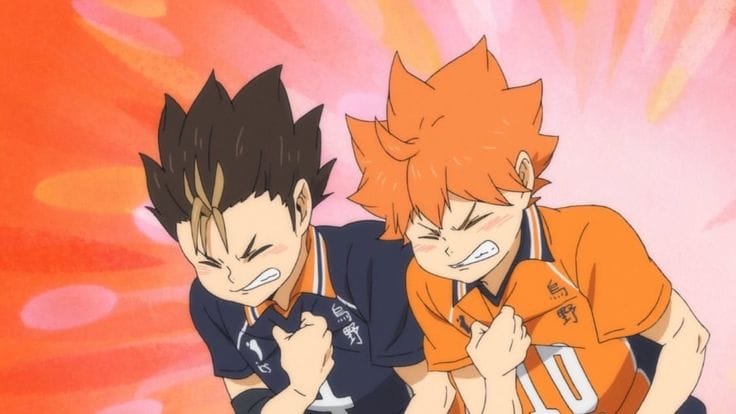
Hinata and Nishinoya, emotionally overwhelmed as usual.
Every team has these people. Nishinoya is Karasuno's libero, the defensive specialist who is not allowed to attack the ball above the net and does not care in the slightest, because to him a perfect dig is just as loud a moment as any kill, so he dives for balls nobody else would chase and then celebrates as if he has just won a championship. And every team, if it is lucky, also has a Tanaka.
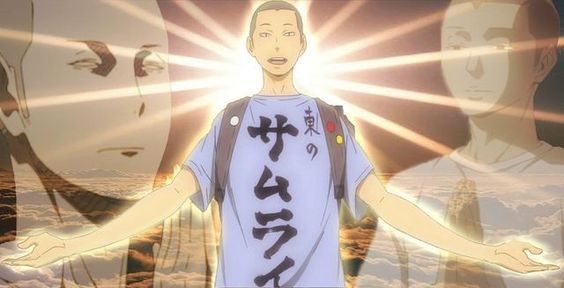
Tanaka, radiating an amount of confidence that should not be possible.
Tanaka is loud, dramatic and ridiculous, and when the team is losing he is often the one who refuses to let anyone's head drop. Most teams have someone like that, and you never appreciate them enough until the score is bad and the gym has gone quiet and one voice starts yelling "one more, one more" as if the game has only just begun.
What it actually taught me
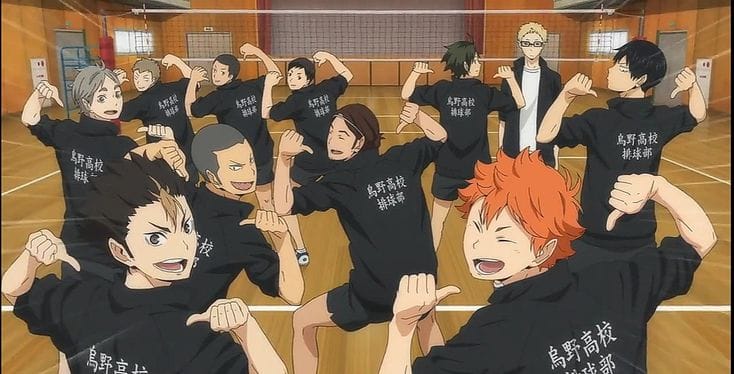
Karasuno. Nobody wins alone, and they would all like you to know that.
In volleyball, teamwork is not a slogan so much as the rules of the game. You cannot touch the ball twice in a row, so you literally need someone else to get it to you, and the best player on the court is useless if the pass before them is bad. That is why Haikyuu hits so hard, because Kageyama becomes great not when his sets get better but when he finally starts setting for the people in front of him. Resilience, meanwhile, is built into a scoreline you cannot escape. Every rally ends with a point, for you or against you, and there is no stalling and no running down the clock, so when you lose a point you rotate and have to be ready for the next serve within seconds. Karasuno loses a lot, and every time the story asks the same question of them, which is what they are going to do with the next point.
That is the lesson I carried off the court as well. You will mess up the pass, the set will be off and the block will stuff you, and that is fine, as long as you rotate, reset and call for the next ball.
Still calling for the ball
I still play, and every good hit still reminds me of the setter who made it possible, because I used to be that person. Class 7 me picked volleyball because he thought it was easy, and he was completely wrong about that, and completely right about everything else.
Haikyuu!! was created by Haruichi Furudate and serialised in Weekly Shōnen Jump, with the anime produced by Production I.G. If it ever made you want to jump a little higher, go and support the official releases.
Enjoyed this article?
Leave a like to let me know this was valuable to you.
- Anonymous Libero
Nothing beats the sound of a clean receive. Beautiful piece of writing.
- Anonymous Dev
Reading this made me want to lace up my court shoes and play under the lights again.
- Anonymous Volleyball Fan
Oikawa's monologue about talent being something you make bloom and instinct being something you polish resonates so deeply.
- Anonymous Reader
Sports anime really do teach some of the most profound lessons on perseverance and embracing the grind.
- Anonymous Wing Spiker
That quote about the ball not hitting the floor as long as someone connects with it... hits right in the feels every time.
Discussion
(6)