How a puzzle written on a Soviet research computer became the reason millions bought a Game Boy, through a tangle of licences, a trip to Moscow, a courtroom fight and one very good pack-in decision. With a playable Tetris and a leaderboard.
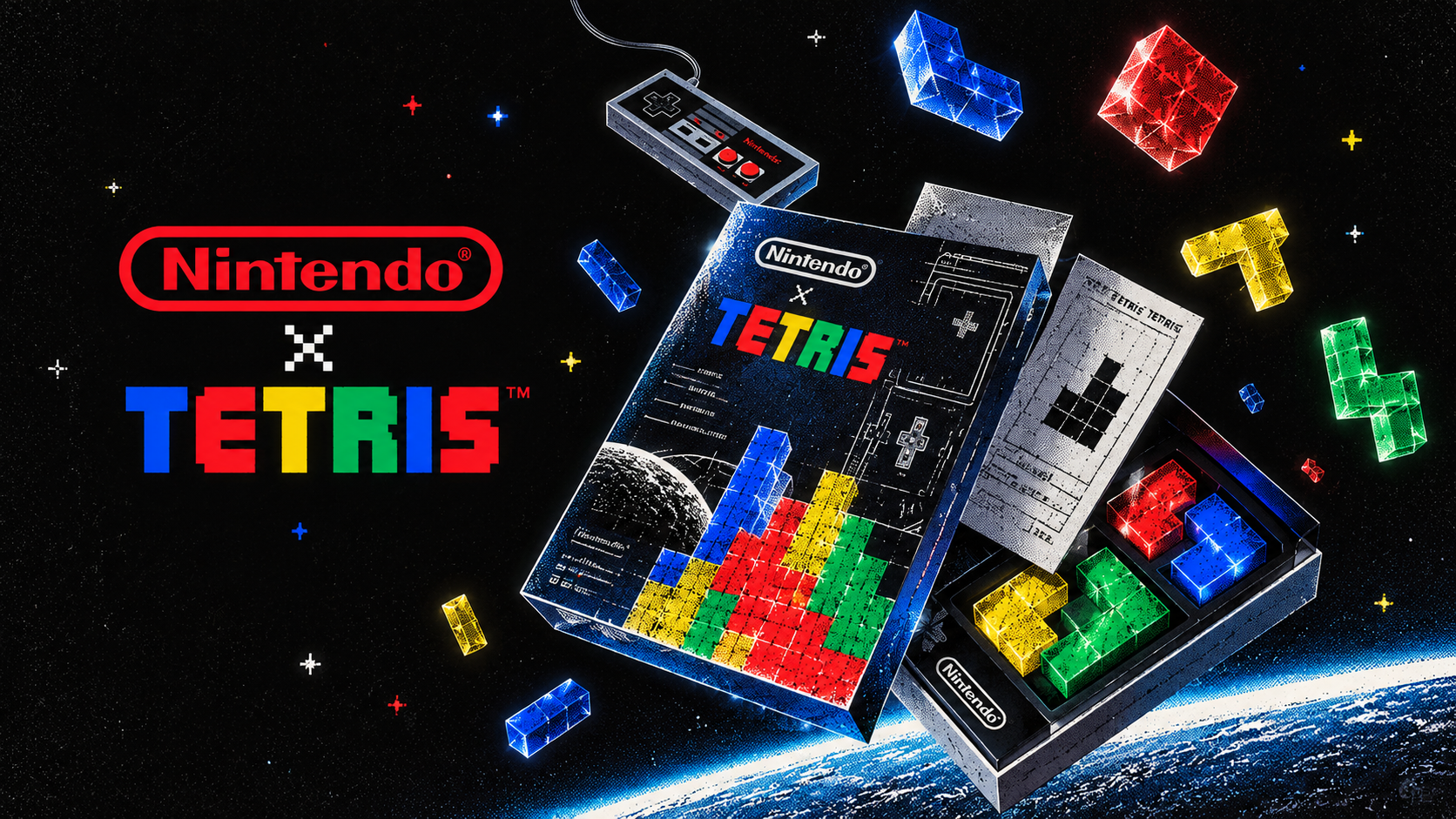
Some games succeed because they are clever, and some succeed because they arrive at exactly the right moment in exactly the right hands. on the Game Boy managed both. It is a puzzle that was written on a Soviet research computer, passed around on floppy disks, fought over by companies on three continents and finally bundled with a small grey handheld, where it became one of the best-selling games Nintendo has ever released. The story of how it got there is almost as satisfying as a four-line clear.
A puzzle from the Academy of Sciences
In June 1984, Alexey Pajitnov was a researcher at the Soviet Academy of Sciences' computer centre in Moscow, where part of his work was testing what the institute's Electronika 60 computer could do. Inspired by pentomino puzzles, in which shapes made of five squares are fitted together, he built a simpler game out of four-square pieces that fell into a well, one at a time, and disappeared whenever they completed a row. He named it after the Greek prefix for four and his favourite sport, tennis, and called it Tetris.
The game had no graphics to speak of, but it did not need any. It spread quickly through Moscow's computer circles, especially once Vadim Gerasimov ported it to the IBM PC in 1985, and copies soon made their way out of the country. What travelled with them, unfortunately, was a great deal of confusion about who actually owned the right to sell it.
Everyone thought they owned it
In the Soviet Union of the 1980s, a researcher could not simply license his own work to a foreign company. Software created at a state institute belonged to the state, and foreign deals were meant to go through an organisation called Elektronorgtechnica, usually shortened to Elorg. Robert Stein of the British company Andromeda had seen the game and set about acquiring the rights, working with Pajitnov and with Hungarian programmers who had encountered it, and he went on to sell those rights to Mirrorsoft in Britain and Spectrum HoloByte in the United States. The trouble was that the paperwork had moved faster than the Soviet authorities, and when Elorg finally became involved, it made clear that a great many of the rights being sold on had never been properly granted in the first place. Mirrorsoft, in turn, sublicensed console rights to Atari Games, which built its own plans for the game on that contested chain of licences, and that would matter a great deal very soon.
This is where the story stops being about a puzzle and starts being about who was holding the right piece of paper.
The man who went to Moscow
Henk Rogers, a Dutch-born game publisher running his own company in Japan, first saw Tetris at the 1988 Consumer Electronics Show in Las Vegas and, by his own account, could not stop playing it. Nintendo was then preparing a handheld console, the Game Boy, and Rogers became convinced that this particular game and that particular machine belonged together. He took the idea to Minoru Arakawa, the president of Nintendo of America, and to Howard Lincoln, Nintendo's general counsel, who were interested on one condition: that he could actually secure the handheld rights.
So in early 1989, Rogers went to Moscow and tracked down Elorg directly, at a time when a Western businessman turning up unannounced at a Soviet ministry was not a routine event. He came away with an exclusive licence for handheld versions of Tetris, and shortly afterwards he returned with Arakawa and Lincoln to secure the rights for home consoles as well. For the first time, the rights that mattered most were coming straight from the people who could actually grant them.
A courtroom, and a recall
Atari Games, through its Tengen label, had released its own Tetris for the Nintendo Entertainment System in May 1989, based on the rights it believed it held through the Mirrorsoft chain. Tengen and Nintendo were already in legal conflict, and in April 1989 Tengen had sued Nintendo over the right to publish Tetris on the NES, with Nintendo countersuing. The court sided with Nintendo. In June 1989, US District Judge Fern Smith issued an injunction that barred Tengen from distributing its version, finding that neither Mirrorsoft nor Spectrum HoloByte had ever held the home console rights they had passed on. Tengen's cartridges had to come off the market almost as soon as they arrived, and that version has been a collector's curiosity ever since.
Pack in Tetris
The Game Boy went on sale in Japan on 21 April 1989, and Tetris followed there on 14 June. For the launch in North America on 31 July 1989, Nintendo made a decision that shaped the next decade of handheld gaming: instead of shipping its new machine with a Mario game, it put Tetris in the box.
Rogers had argued for exactly that, telling Arakawa, in words he has repeated many times since, that if Nintendo wanted little boys to buy the Game Boy it should pack in Mario, but if it wanted everyone to buy it, it should pack in Tetris. He was right. Tetris was the kind of game that parents, office workers and grandparents picked up as easily as children did, and its rules could be understood in seconds on a small, green, unlit screen. It was also the first game to support the Game Link Cable, which let two Game Boys connect for head-to-head play, so a pack-in game quietly became a social one as well.
The result was one of the most successful pairings in the history of the medium. Tetris sold 35 million copies on the Game Boy alone, and the Game Boy became the machine that made handheld gaming mainstream. For Nintendo, the right game turned a new device into a habit, and for millions of people Tetris was simply the thing the Game Boy was for.
Where the blocks landed
Pajitnov himself saw very little from the game's early success, because the rights had never been his to sell. That changed at the end of 1995, when the rights Elorg had arranged a decade earlier reverted to him, and together with Henk Rogers he went on to set up The Tetris Company to manage the licence. The friendship that began in Moscow outlasted the Soviet Union itself, and it is one of the reasons the story is remembered as fondly as it is.
What makes the Game Boy chapter so interesting, looking back, is how many different things had to fall into place at once: a game simple enough to explain in a sentence, a handheld that needed a reason to exist, a publisher willing to fly to Moscow, a company willing to bet its launch on a puzzle instead of its mascot, and a court ruling that cleared the board at exactly the right time. It is, fittingly, a story about pieces landing in the right place.
Your turn
Here is a real, playable Tetris, with the classic pieces, rotation with wall kicks, a ghost piece, hold and levels that speed up as you clear lines. Enter a name, press Start, and see if you can make the top five. On a phone, press Lock to give the game the whole screen, and Exit when you want to come back to the page.

Click the game first. ← → move · ↑ or X rotate · Z rotate back · ↓ soft drop · Space hard drop · C or Shift hold · P or Esc pause. On a phone, press Lock to give the game the whole screen.
Top 5 players
Loading scores…
Enjoyed this article?
Leave a like to let me know this was valuable to you.
- Anonymous Reader
Gripping narrative flow. Read like a thriller novel from start to finish.
- Anonymous Product Strategist
Killer apps define platforms. Without Tetris, Game Boy might have lost ground to the Sega Game Gear or Atari Lynx despite superior battery life.
- Anonymous Retro Collector
Still have my original grey brick Game Boy with the Tetris cartridge loaded. That Korobeiniki theme music is burned into my brain forever.
- Anonymous Game Dev
Alexey Pajitnov's pure mathematical puzzle design combined with Gunpei Yokoi's rugged hardware design created the ultimate timeless classic.
- Anonymous Hardware Hacker
Bundling Tetris instead of Mario with the Game Boy was such a counterintuitive masterstroke from Henk and Arakawa. It sold the hardware to businessmen and parents, not just kids.
Discussion
(6)