A technical look at Jev, TypeSafe AI's System One model. How it skips token-by-token generation, returns typed answers with calibrated probabilities in a single pass, what that costs and where it fits next to language models.
Most of the conversation about AI models is about models that talk. They write, explain, summarise and reason out loud, and the way they do it, one token after another, has become so familiar that it is easy to forget it is a design choice. A large share of what software actually needs from intelligence, though, is not prose at all. It is a decision: is this message urgent, which team should handle it, how risky is this transaction, should this command be allowed to run. Those are the moments where code reaches an if statement it cannot write by hand.
Jev, from TypeSafe AI, is built for exactly those moments. It launched on 15 September 2026, alongside a $40 million seed round led by DCVC, and TypeSafe describes it as the first of a new class it calls System One models, and sums it up as "a frontier-intelligence function call": unstructured state goes in, and typed, probabilistic decisions come out. This post walks through what that means technically, how it differs from a language model, and where it fits.
Two kinds of thinking
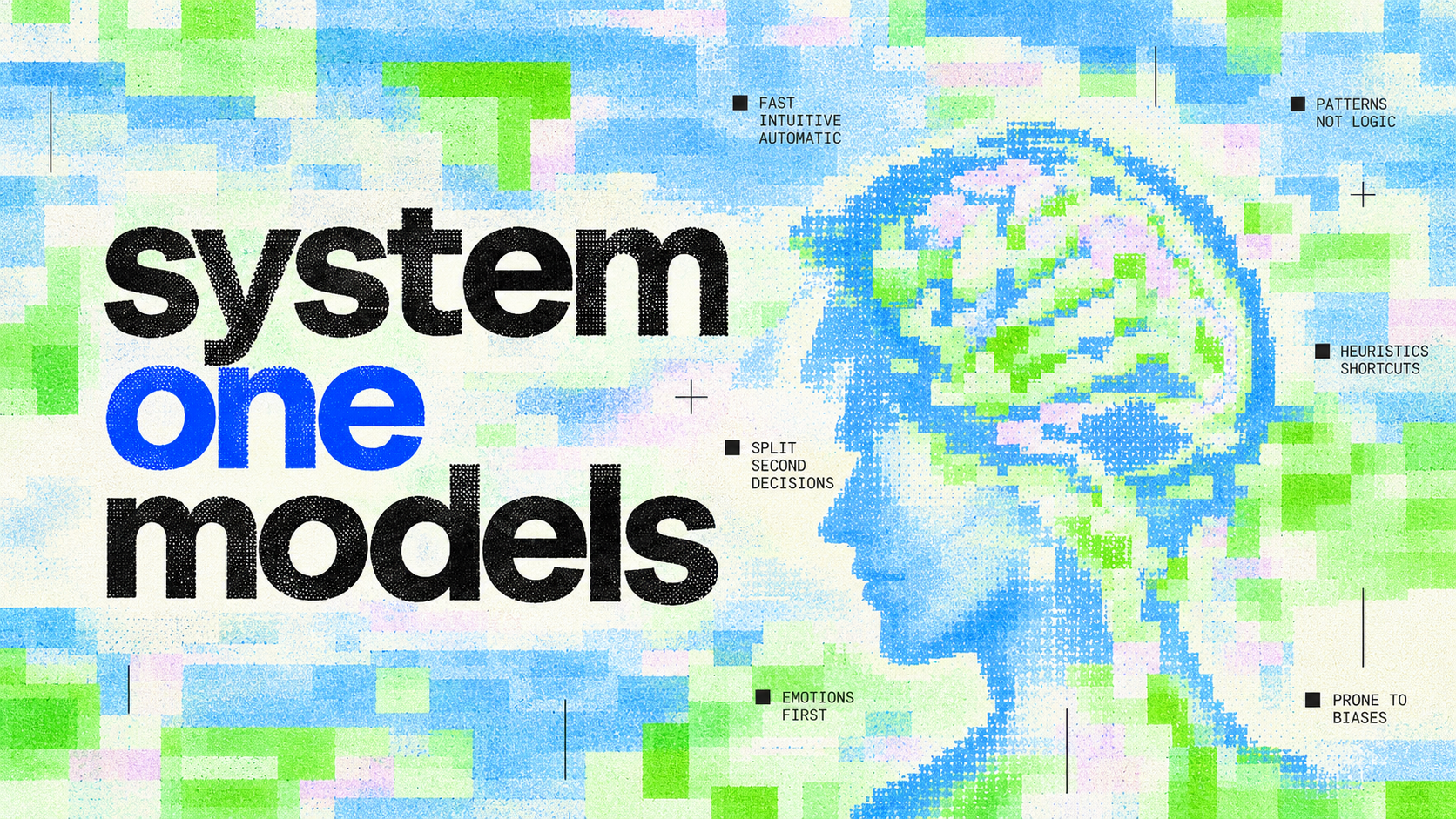
The name comes from Daniel Kahneman's Thinking, Fast and Slow, which describes two modes of human thought. System 1 is fast, intuitive and automatic, the kind of judgement you make without stopping to think. System 2 is slow and deliberate, the kind you reach for when a problem needs step-by-step reasoning. Kahneman's point was that most of what people do all day runs on System 1, and that System 2 is expensive and used sparingly.
TypeSafe maps that onto AI models directly. Reasoning language models are System 2: they think through a problem by generating text, sometimes a great deal of it, before they answer. Jev is meant to be System 1, handling the fast, frequent judgements while reasoning models handle the rest. TypeSafe acknowledges that human System 1 thinking is associated with error, and argues that a model built for this kind of decision can be made more reliable than the alternatives rather than less. The model's name is a nod to William Stanley Jevons and the Jevons paradox, the observation that making a resource cheaper tends to increase how much of it gets used. The bet is that very cheap, very fast decisions will be used everywhere.
One pass instead of one token at a time
To see why Jev can be fast, it helps to be precise about why language models are slow. A language model is autoregressive. It produces its output one token at a time, and every token depends on all of the tokens before it, so the model has to run once per token, in sequence. Asking a language model for a decision means asking it to write the decision out, often with reasoning first, and then parsing that text back into something code can use.
one pass
- Sequential vs parallel
- Typed outputs
- Latency
A language model answers by generating text one token at a time, and each token waits for the one before it.
Jev does not generate text. According to TypeSafe, it gives up string generation entirely and outputs all of its probabilities in parallel, in a single query, rather than token by token. Every question in a request is evaluated against the same input independently, so one answer never becomes context for another. The practical effect is latency measured in milliseconds rather than seconds. TypeSafe's comparison puts Jev at 70 to 500 ms end to end, against 3 to 329 seconds for frontier language models on the same kind of task, and describes the difference as 40 to 200 times faster for what it calls System One shaped queries. Flavio Copes, who tested it in depth, reports that most calls complete in around 100 milliseconds.
TypeSafe has not published Jev's architecture, weights or a technical paper. What it has described is a stack of three parts: a new model architecture, a parallel sampler designed to be hardware efficient, and a training method it calls Reinforcement Learning for Calibrated Decisions, which comes up again below.
State in, types out
A request to Jev has two parts. The first is the state, the situation being judged, which can be a string, a JSON object or an array of text. The second is a set of typed questions about that state. Each question has a type, a set of instructions written in natural language and, depending on the type, criteria that describe the possible answers.
state in, types out
- Noul
- Choice
- Score
State
“Help! My payouts have been failing for 3 days.”
Questions
is_urgent noul
true or false
department choice
billing · sales · technical
frustration score
calm → frustrated → very angry
Answers
is_urgent
0.95probability
department
billingconfidence 0.80
frustration
1.04confidence 0.94
The input is the state: a string, a JSON object or an array of text describing the situation.
There are three question types. A noul is a yes-or-no question answered with a single probability. A choice picks one option from a list of labelled options. A score places the state on an ordered scale of levels. In the example above, taken from Cloudflare's documentation, one short support message is asked all three at once, whether it is urgent, which department should take it and how frustrated the customer is, and the answers come back in the same response. A detail worth knowing is that the key used to name a question is not sent to the model, so everything the model needs has to be in the instructions themselves.
Because the output is always one of these types, Jev cannot return a malformed answer. TypeSafe states that the model never makes type errors, and is careful to add that this is a structural guarantee rather than an empirical one. The answer always matches the schema, but matching the schema says nothing about whether the answer is correct.
Answers that come with odds
The most important difference from a language model may be that every answer carries its uncertainty with it. A language model's answer is a piece of text. It might sound confident or hesitant, but there is no number underneath it that code can act on.
answers with odds
- Probabilities
- Confidence
- Calibrated
A noul is a single probability between 0 and 1. For is_urgent the model returns 0.95, and that number is the answer.
A noul answer is simply a probability between 0 and 1, and that probability is the answer. A choice answer returns the selected option along with a probability for every option, plus a confidence value between 0 and 1 that is computed from the shape of that distribution, so a clear winner scores higher than a near tie. A score answer returns a probability for each level along with a score that is the probability-weighted mean of the levels, which is why the example lands at 1.04, fractionally above the "frustrated" level rather than exactly on it. This gives calling code something much richer than a label: it can act immediately when the model is sure, and escalate to a person or a slower model when it is not.
Calibration is the point
Probabilities are only useful if they mean what they say. A model is calibrated when its stated confidence matches how often it is actually right, so that across many answers given 90 percent, about 90 percent turn out to be correct. Many models are not like this. A system that says 90 percent but is right 70 percent of the time is overconfident, and any logic built on its numbers will quietly make the wrong trade-offs.
calibrated odds
- Reliability diagram
- RLCD
- Illustrative
An overconfident model says 90% and is right far less often, so its points sag below the diagonal.
This is what TypeSafe's training method targets. Reinforcement Learning for Calibrated Decisions optimises for what TypeSafe describes as epistemically honest probabilities, rewarding the model when its probabilities match real outcomes, rather than rewarding answers that people prefer, as reinforcement learning from human feedback does, or answers that can be mechanically verified. A consequence is that the numbers have to be read honestly too. A noul of 0.5 does not mean "medium". It means the model cannot tell. TypeSafe has not published a reliability curve, so the diagram above illustrates the concept rather than measuring Jev.
Limits worth knowing
Jev is deliberately narrow, and its limits follow from its design. It cannot write anything, which rules out replies, summaries, code and explanations. Input is text only, with no images, audio or video. Flavio Copes documents the size limits as roughly 64,000 tokens shared between the state and all of the questions, with the state plus the longest single question limited to about 32,000 tokens, and Cloudflare lists a context window of 32,000 tokens. A choice can have up to 255 options, which TypeSafe handles above that with a two-stage process, and a score can have between 2 and 10 levels.
There are also practical lessons from people who have used it. Because a choice question must always pick one of the options it is given, a list should usually include an "other" option. Accuracy falls when the state is padded with irrelevant material, so it pays to send only what the questions need. And any single answer can still be wrong. Calibration makes the model honest about its uncertainty, but it does not make that uncertainty disappear. Copes's notes also list arithmetic, counting, date comparisons and double negatives as weak spots, and TypeSafe itself lists System 2 tasks, specialised domains and anything generative as outside what Jev is for.
Where it fits
The pattern that falls out of all this is to let Jev decide and let a language model write. The fast, cheap model makes the frequent judgement calls, and the slower, more expensive one is only invoked when words are actually needed.
decide, then write
- Routing
- Guardrails
- Hybrid
A support message arrives: payouts have been failing for three days.
TypeSafe's suggested uses follow the same shape. They include routing and classification in automated workflows, map-reducing over large datasets, real-time applications such as games and simulations, and verification tasks like scoring, judging, guardrails and jailbreak detection. Copes adds search re-ranking, safety checks in front of shell commands and choosing which model should handle a task.
Cost is the other half of the argument. TypeSafe prices input at $0.042 per million tokens, and output is free, which it describes as too cheap to meter. For comparison, it lists frontier language model input prices from $0.20 to $10 per million tokens, with output typically around five times more. The headline claims on TypeSafe's site, 193.6 times faster and 444.6 times cheaper, come from its own workflow evaluations, and TypeSafe notes that it expects these to sit at the higher end of real-world gains. Treating them as a ceiling rather than a typical result is the sensible reading. Jev is available through TypeSafe's own API, on Cloudflare Workers AI as typesafe/jev and through the Vercel AI Gateway.
A different primitive
What makes Jev interesting is less any single benchmark than the idea behind it. For the last few years, adding intelligence to software has mostly meant calling a model that talks and then working out what it meant. A System One model turns that intelligence into something closer to a typed function: a call you can make thousands of times, in milliseconds, that returns a value your code already knows how to handle, together with an honest estimate of how much to trust it. Whether Jev itself becomes the standard for that role remains to be seen, but the shape of the idea, fast calibrated decisions on one side and slow deliberate reasoning on the other, feels like one that will outlast any single model.
_Sources: Introducing System One Models and Jev on the TypeSafe AI blog, Jev on Cloudflare Workers AI, A deep dive into Jev by Flavio Copes, and Jev (AI model) on Wikipedia.*
Enjoyed this article?
Leave a like to let me know this was valuable to you.
- Anonymous Developer
Excited to test Jev in our real-time streaming pipeline. Great technical breakdown.
- Anonymous AI Engineer
The latency vs accuracy Pareto frontier breakdown was super illuminating. We need more models tuned for fast reactive feedback loops.
- Anonymous Research Scientist
TypeSafe AI is doing genuinely interesting work on deterministic boundaries around neural predictions. Great analysis of their benchmark numbers.
- Anonymous Compiler Dev
Sub-millisecond inference for instant code completion and intent routing makes Jev super exciting compared to bulky multi-billion parameter autoregressive models.
- Anonymous ML Engineer
Fast, low-latency heuristic fast-thinking models (System 1) paired with tree-search reasoning models (System 2) is the exact dual-process architecture cognitive computing needed.
Discussion
(5)