Curiosity, taking things apart, and a few people I learned from. Where my way of designing systems came from.
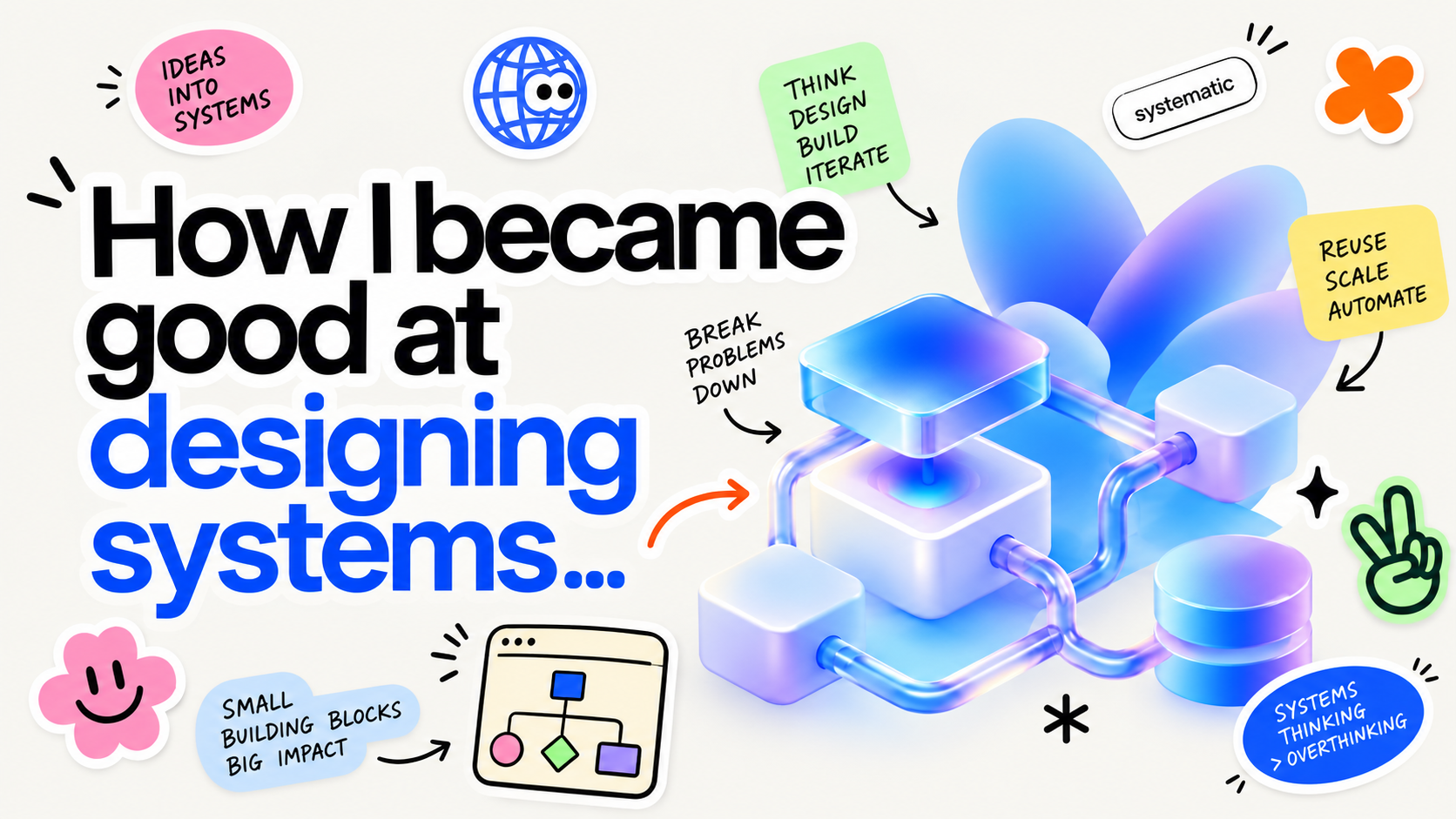
People sometimes ask how I got good at designing systems. I never really planned to. I just wanted to know how things worked, and I kept asking.
Why does a fan start when you press the button? Why does a page load faster the second time? Why do some people stay calm in front of a messy problem while others get stuck? Usually nobody explained it to me, so I tried to work it out myself. It started with machines and slowly became the way I approach most things.
This post is about where that habit came from.
Watching people figure things out
Before I understood any machine, I watched people solve problems.
My father was the first. When something stopped working, he did not give up on it. He would look at it, try one thing, see what changed, then try the next. I did not have a word for it then, but he was debugging.
My better teachers worked the same way. They did not just give us the answer. They showed us what they noticed first, what they asked next, and where they got stuck.
What I took from them is that figuring things out is a process, not a gift. You can learn it.
The loop
How I watched people figure things out
Notice
Something behaves in a way you did not expect.
Ask why
Make a guess about what is going on.
Rebuild
Put it back together, usually a bit better.
Take it apart
Split it into pieces small enough to check.
You notice something, ask why, take it apart, and put it back together. Then you notice something new and go around again. I still do this every day, just on bigger problems.
My uncle's electronics shop
My uncle works in an electronics shop, and I spent a lot of time watching him.
His counter was always covered in radios, chargers, remotes and loose boards, most of them open. From the outside a radio looks like one object. With the cover off, it is a speaker, a board, a battery and a knob, each doing one job and connected to the others in a specific way.
On the counter
A radio with the cover off
When something was broken, he did not stare at the whole device. He checked one part at a time: what goes in, what comes out, and whether that looks right. He kept narrowing it down until he found the fault. Years later I noticed I debug distributed systems the same way. The parts are services instead of capacitors, but the approach is the same.
The same habit, outside of work
There is no manual for most things in life either.
A lot of what I know, I learned by getting it wrong first and then working out why. Learning to code, building my first products, deciding what kind of work I wanted to do. Nobody gave me the steps, so I used the same loop: look at what is happening, ask why, break it into parts I can deal with, and adjust.
It made me more comfortable with not knowing things. Not knowing is just where you start.
People I learned from
A lot of my direction came from people I read about and watched. I never met any of them, but when I am stuck I still ask myself how one of them might approach the problem.
People I learned from
Six people I think about when I am stuck
Where you start does not decide where you end up. He dreamed big and still did the engineering himself.
A. P. J. Abdul Kalam grew up in Rameswaram and went on to lead India's first satellite launch vehicle project. He talked about dreams, but he also did the engineering, and that combination stuck with me.
Steve Jobs said design is not just what something looks like and feels like; design is how it works. That line is a big part of why I care about the inside of a system and not only the surface.
Linus Torvalds started Linux as a student project, and later wrote Git to solve his own problem. He did not wait for anyone's permission to build something serious.
Jeff Dean and Sanjay Ghemawat built core parts of Google's infrastructure, like MapReduce and Bigtable, often writing code together at one keyboard. Reading about their work is what got me interested in systems at scale, and in making large systems simple to use.
Sundar Pichai grew up in Chennai and now leads Google. I like that he is ambitious without being loud about it.
I wanted to go to space
Before software, I wanted to work on rockets.
I read about launches, orbits and engines, and I think it shaped how I think. On a rocket, every part is there for a reason, the parts depend on each other, and the whole thing has to work the first time, because you cannot stop and fix it on the way up.
The old dream
Build the thing that gets us there
That taught me to think about failure early: what can break, what happens when it does, and how the rest of the system keeps going. I have not been to space. I still think about systems that way.
How I design systems now
Today I build backend and AI systems, and all of this shows up in how I work.
I start the way my uncle did at his counter: what are the parts, and what is each one responsible for? I pay attention to the boundaries between them, because that is where things usually go wrong and where they are easiest to test. I ask what fails and what the rest of the system does when it does. I try to keep the complicated parts hidden from the people using it. And I care about how it works, not just how the diagram looks.
Today
A small backend, drawn the way I think about it
People call it system design. For me it is the same curiosity I had as a kid, with more structure: small parts with clear jobs, data moving between them on purpose, and the same loop of noticing, asking why, taking it apart and rebuilding.
If you like knowing how things work, keep asking and keep taking things apart. It adds up over time.
Enjoyed this article?
Leave a like to let me know this was valuable to you.
- Anonymous Staff Engineer
Great takeaway on communication: if you can't sketch the data flow and failure path on a whiteboard in 5 minutes, you don't understand it yet.
- Anonymous Student
What resources or whitepapers would you recommend for getting deeper into consensus algorithms and distributed storage?
- Anonymous Founder
Simple systems that work reliably beat complex architectures every day of the week. Loved your emphasis on simplicity.
- Anonymous Backend Engineer
System design is fundamentally about managing constraints and failure domains. You articulated that progression so clearly.
- Anonymous Junior Dev
The mental models section demystified so much for me. Understanding trade-offs rather than searching for 'best practices' was an eye-opener.
Discussion
(6)