Planned streets, shared standards, trade by sea and a changing climate. What a 4,500 year old civilisation looks like next to the way we live now.
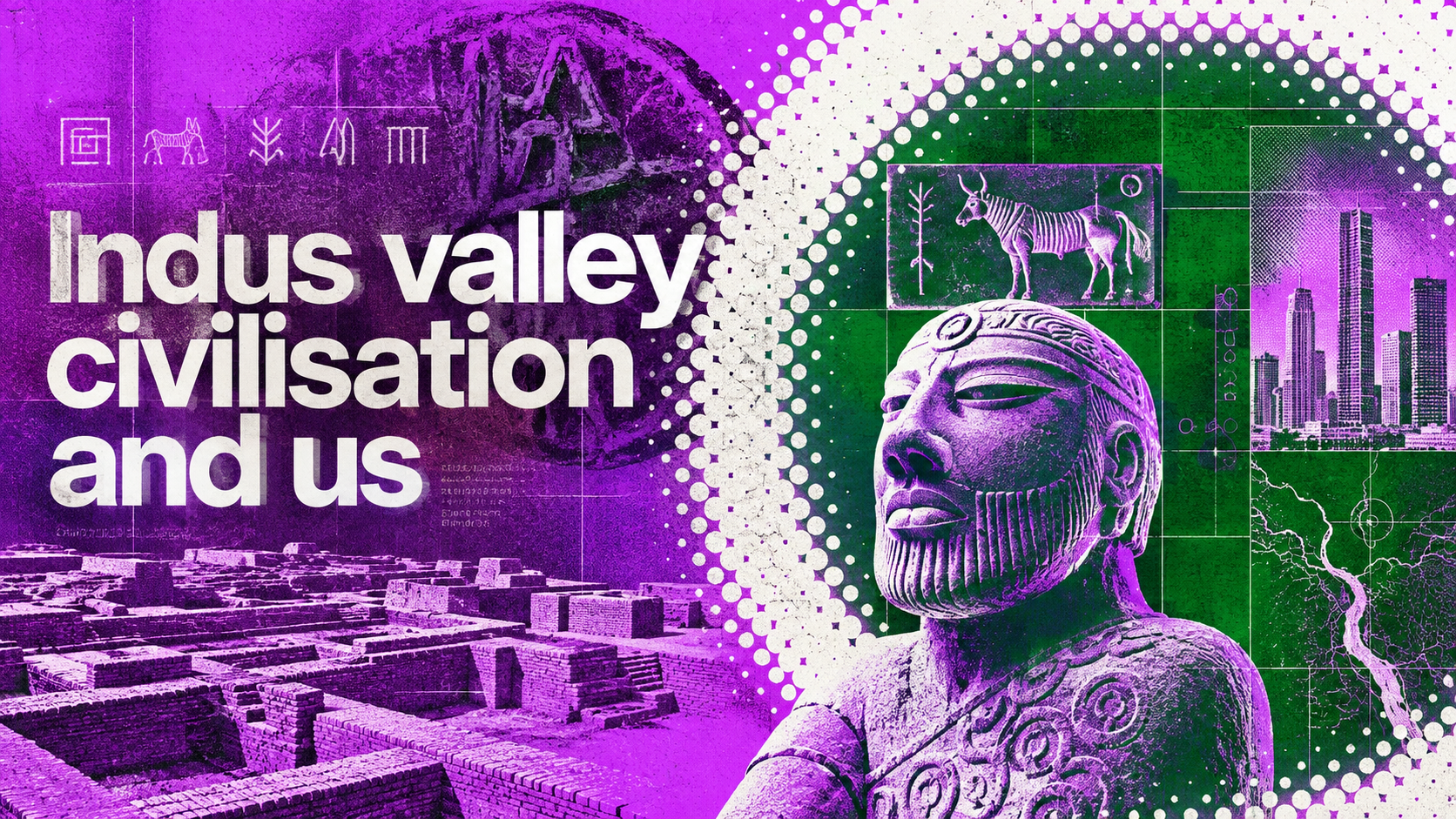
The man on the cover is only about 17.5 centimetres tall. He is a small steatite figure found at Mohenjo-daro, with a band around his forehead and a cloak covered in trefoil patterns. Archaeologists call him the Priest-King, but that name is a guess. Nobody knows whether he was a priest, a king, or neither.
That is a good summary of the Indus valley civilisation. We know a lot about how its people lived: how they built their houses, what they traded and how they measured things. We know very little about what they believed, who was in charge, or what they called themselves.
I keep coming back to it because it is one of the few places where you can see a society solving the same problems we still work on: how to plan a city, how to agree on standards, how to trade with strangers, and what to do when the climate changes. This post walks through those, and how they compare with our time.
How far back this is
Until the 1920s, most history books started the story of the subcontinent much later. Then Daya Ram Sahni excavated Harappa in 1921, R. D. Banerji started work at Mohenjo-daro in 1922, and in 1924 John Marshall announced that the two sites belonged to the same, much older culture.
It turned out to be spread across much of what is now Pakistan and northwest India, with more than a thousand known sites. Its cities were at their largest between about 2600 and 1900 BCE, around the same time Egypt was building pyramids and Mesopotamia was building ziggurats.
Timeline
How far back this is
One comparison helps me with the scale. By the time Rome was founded, Mohenjo-daro had already been mostly empty for more than a thousand years.
A city planned before it was built
Mohenjo-daro probably held around 40,000 people at its peak. What stands out is not its size but how ordered it is. The city has a raised citadel on the west, with the Great Bath: a brick pool about 12 by 7 metres, sealed with a layer of bitumen to keep the water in. To the east is the lower town, laid out in blocks, with main streets running roughly north to south and east to west.
Mohenjo-daro, c. 2500 BCE
A city planned before it was built
The part I find most impressive is the least glamorous. Many houses had a bathroom, and the bathrooms drained into covered brick drains running along the streets. The drains had openings so they could be cleaned. Someone decided where the water would go before the houses went up.
Not every Indus town was this tidy, and much of what we see at Mohenjo-daro was rebuilt several times. Still, compare it with a lot of modern cities, including many in India, where drains are added after the buildings. You can see the difference every monsoon, when streets turn into rivers.
Agreeing on the same numbers
Across hundreds of sites, bricks were made in the same proportion, with thickness, width and length in a ratio of 1 to 2 to 4. Weights were standardised too. Traders used small cubes of polished chert, and the weights follow a clear series: each one is double the last, up to 64, before switching to larger steps.
Standard weights
Each weight is double the last
We rely on the same kind of agreement today. The metric system, shipping containers, USB-C and memory sizes of 8, 16 and 32 gigabytes all work because a lot of people agreed on the same numbers.
What we do not know is how the Indus people reached that agreement. There is no clear evidence of an empire or a conquering king that imposed it. Somehow, towns hundreds of kilometres apart kept to the same rules for centuries.
Trade across the sea
The Indus cities did not keep to themselves. Goods moved by river and bullock cart to the coast, and from there by sea along the Gulf. Mesopotamian texts talk about ships from a place called Meluhha, which most scholars identify with the Indus region. Sargon of Akkad boasted that ships from Meluhha docked at his capital.
Trade
From the Indus to Mesopotamia
The evidence turns up on both ends. Carnelian beads made in the Indus style were buried in the royal graves at Ur. In Dilmun, modern Bahrain, merchants used weights on the Indus standard. Indus seals were pressed into clay to seal bundles of goods, a little like the labels and barcodes on packages today.
It was not globalisation in our sense. But it was a network of producers, middlemen and ports, where people who never met relied on shared marks and shared weights to trust each other.
A script we still cannot read
The Indus people wrote. We have thousands of short inscriptions, mostly on seals, using around 400 different signs. We cannot read any of them.
The script
Still unread
~400
distinct signs
~5
signs in a typical text
0
bilingual texts found
Part of the problem is length. A typical inscription is only about five signs long, which is closer to a name or a label than a sentence. There is also no bilingual text, like the Rosetta Stone for Egyptian hieroglyphs, that shows the same words in a script we already know. Many decipherments have been proposed. None has convinced most researchers.
I think about this when I think about our own records. We write more than any society before us, but a lot of it lives in file formats and services that may not exist in fifty years, let alone five thousand. Most of us already have old files we cannot open. The Indus people at least wrote on stone and fired clay.
What is missing
There are also things we do not find. There are no clear palaces, no grand royal tombs, and very few monuments that show a ruler defeating enemies. Weapons are rare compared with other civilisations of the same age.
This does not mean there were no rulers or no conflict, and researchers still argue about how Indus society was organised. But it is unusual. Our own cities are full of statues, towers and buildings named after powerful people. The Indus cities put their effort into walls, drains, granaries and baths.
Less a collapse than a slow move
After about 1900 BCE, the large cities were slowly left behind. There is no sign of one big invasion or disaster. What happened seems to have been gradual.
Many researchers link it to changes in climate. The monsoon weakened over this period, and the Ghaggar-Hakra river system, which once supported many settlements, carried less and less water. Rivers shifted course. Over a few centuries, people moved east and south, into smaller villages, and the shared standards of the big cities faded.
After 1900 BCE
Less a collapse than a slow move
This is the part that feels closest to us. The Indus people dealt with a changing climate by moving, slowly, over generations. We are facing faster changes, with far more people, fixed borders and cities that cannot be picked up and moved. The same rivers still support millions of people today, in cities like Lahore and Delhi.
What I take from it
When I read about the Indus valley, what stays with me is not a single monument. It is the ordinary things they did well: drains that were planned, bricks and weights that matched across a whole region, and trade that worked because people agreed on the rules.
Those are the things that made their cities work, and most of them are invisible when they are working. That is still true for us. We tend to notice our infrastructure only when it fails.
The civilisation did not end in one day, and it did not vanish completely. Its people moved, adapted and became part of what came next. We are, in a real sense, still living on the same rivers, dealing with many of the same problems.
Enjoyed this article?
Leave a like to let me know this was valuable to you.
- Anonymous Archeology Buff
Really enjoyed this read. History has so many overlooked engineering lessons.
- Anonymous Engineer
Standardization of units and protocols enabled trade across thousands of kilometers. Same exact principle behind the Internet protocol suite.
- Anonymous Reader
Fascinating perspective on civilizational sustainability. The absence of ostentatious palaces and focus on public utility is something we should reflect on.
- Anonymous Urban Planner
Grid layouts, water harvesting, and civic foresight. We still struggle with municipal drainage in cities today while they solved it 4,500 years ago.
- Anonymous History Enthusiast
Harappa and Mohenjo-daro's standardized brick ratios and subterranean drainage systems were thousands of years ahead of their time. Brilliant parallel to modern modular engineering.
Discussion
(5)